
Towns County Sex Offender Checks
The Georgia Sex Offender Registry is the official starting point. The Georgia Bureau of Investigation and its Georgia Crime Information Center maintain the statewide system. The Georgia Department of Corrections and State Board of Pardons and Paroles enter certain qualifying records, while GBI enters people who move into Georgia from another state. Towns County Sheriff verifies information supplied by people registered in Towns County. Those linked roles explain why one office cannot answer every question.
Begin with the statewide portal even for a local search. Choose Towns in the county control, or use a known name. If an address seems false or stale, contact Towns County Sheriff at 706-896-4444 rather than confronting anyone. The sheriff and jail complex is at 4070 State Highway 339, Young Harris, Georgia 30582. No separate public Towns County offender map or official registry app was found, so claims about an app-only alert or county list would be misleading.
Three Agencies Update Towns Records
A Towns County registry entry can pass through several custodians. GDC or the Parole Board may create the initial state entry after a qualifying Georgia case. GBI handles qualifying arrivals from other states and maintains the central portal. The registrant then reports to the sheriff for local verification. Under the official GBI registry guidance, a sheriff must enter supplied updates within two business days, and the statewide registry updates daily.
This timeline matters when a move or other change is recent. A brief gap does not prove evasion, and a portal entry does not show where a person is at the instant of search. Save the relevant public details and call law enforcement when the concern involves possible noncompliance. Towns County residents should use the sheriff's main line, while emergencies belong with 911.
Note: The central portal, state agencies, and local sheriff share duties, but each holds a different part of the registration process.
Georgia Sex Offender Registry Searches
The official registry allows several routes into the same public data. A known-name search is useful when identity is the question. The Towns County filter is stronger for a county-wide review. Address and map tools support geographic awareness, though their controls may change and map placement is not proof of a person's current physical location.
- Open the Georgia registry and review any disclaimer or conditions shown.
- Enter a known name or select Towns from the county menu. Add address or map criteria only when those live controls are available.
- Compare the result list by photo, aliases, physical details, and offense information. Do not rely on a name alone.
- Open the full profile, note its status and source fields, and direct local address questions to Towns County Sheriff.
| Field or control | Type | Required | Use |
|---|---|---|---|
| Name | Text | No | Find a person whose identity is known |
| County | Dropdown | No | Select Towns for a local list |
| Address or radius | Text or map controls | No | Review an area when the live tool offers it |
| Disclaimer | Acknowledgment | If prompted | Accept the registry's terms before searching |
The official registry screen is documented by the GBI public search source.
Its county control is the most direct way to narrow public results to Towns County without assuming a city or ZIP boundary.
Towns Registry Pins Are Not Live
A registry address is a reported and verified registration field. It is not a tracking signal. Map precision, recent submissions, geocoding, and the two-business-day sheriff update window can all affect what a viewer sees. A marker near a school, park, or other site does not by itself prove that a registrant violates Georgia law.
Georgia residency limits depend on the relevant statute, conviction date, and personal circumstances. Certain defined groups face 1,000-foot restrictions, but proximity alone cannot supply those legal facts. Report a concrete concern to the Towns County Sheriff. Do not visit the address, photograph residents, or try to enforce a rule yourself.
Registry Profiles: What They Show
Public profile fields help distinguish people and explain why registration is required. They are not a prediction of future conduct. Registration status concerns the person's reported registry standing, while risk classification is a separate review-board category where one has been assigned. Read each in its own field.
| Name and aliases | Published names used to help distinguish the listed person. |
|---|---|
| Photo and description | Current photo when available, plus sex, race, age or birth information, height, weight, hair, eyes, scars, marks, or tattoos. |
| Registered address | The address in the registration record, not a live-location reading. |
| Offense information | The qualifying offense, conviction date, and jurisdiction as displayed. |
| Classification | A risk category when assigned by the state review process. |
| Status and other fields | Registration status and statutory vehicle, school, or related data when published. |
The official registry FAQ gives the rules behind these fields.
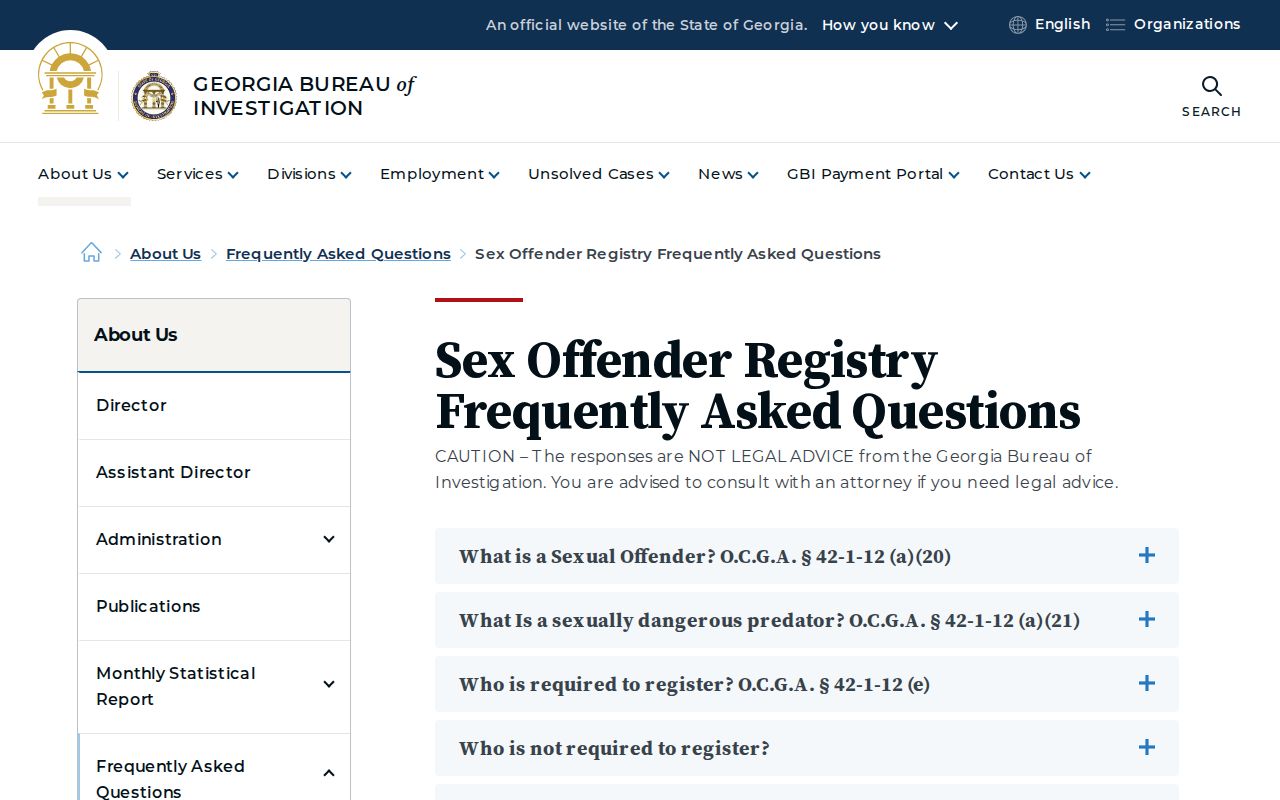
The image illustrates the official interface, while the field table keeps private identifiers out of this local explanation.
GBI and National Registry Layers
The Georgia registry is the authoritative state layer for Towns County entries. The U.S. Department of Justice's National Sex Offender Public Website adds a cross-state search, which helps when a name or recent move crosses Georgia's border with North Carolina. NSOPW gathers results from participating jurisdictions and routes users back to those sources. It does not replace Towns County Sheriff verification.
| Question | Georgia registry | NSOPW |
|---|---|---|
| Best local filter | Towns County selection and Georgia profile | Multi-jurisdiction search |
| Record owner | GBI/GCIC with sheriff verification | Participating jurisdiction supplies data |
| Local correction route | Towns County Sheriff | Follow the linked jurisdiction |
The federal national registry search shows the second layer.
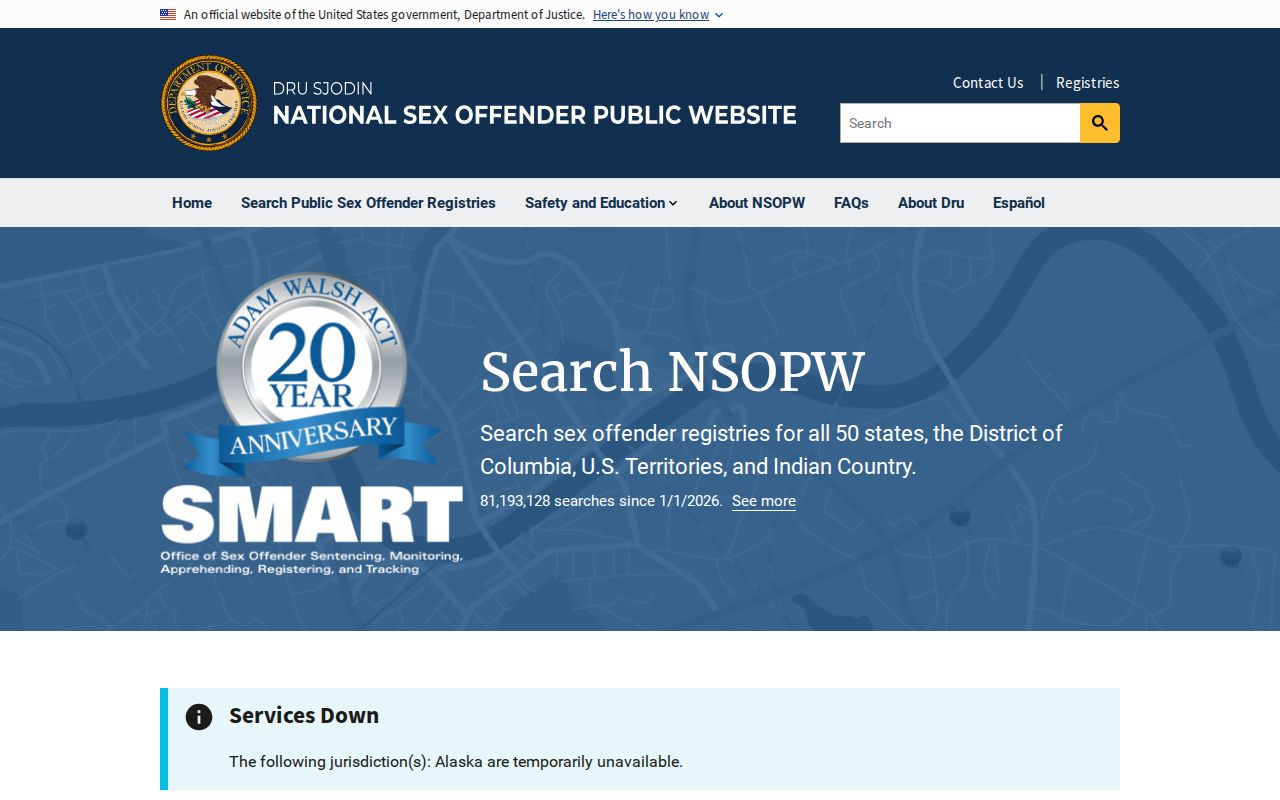
Use it to widen a search, then verify the responsive entry with the agency that maintains it.
Registration Levels and Duties in Georgia
Georgia does not use a simple public federal Tier I, II, and III duration chart. It distinguishes registrants from people designated as sexually dangerous predators, and the Sexual Offender Registration Review Board assigns risk classifications where applicable. Duration and possible release depend on the offense, conviction date, completion of custody and supervision, classification, and any court order.
| Category or duty | Timing or duration | Public meaning |
|---|---|---|
| Initial in-person report | Generally within 72 hours after release, supervision placement, or Georgia entry | Begins or continues sheriff registration |
| Specified changes | Generally within 72 hours | Keeps required data current |
| Annual renewal | Within 72 hours before the birthday | Includes in-person photograph and fingerprints |
| Sexually dangerous predator | Depends on governing law and orders | A distinct Georgia category, not a federal tier label |
| Court release | Only through a qualifying statutory route | Not automatic after a fixed public tier term |
The registry FAQ is the sound source for current reporting rules.
Readers should use the written status and classification fields separately rather than turn them into an invented tier system.
Towns Registration Release Petitions
O.C.G.A. §42-1-19 provides routes for a qualifying person to petition the proper Superior Court for release from registration. Some routes require ten years after completion of prison, parole, supervised release, and probation, or depend on a Level I classification. The offense, dates, supervision record, and court findings control. A denied petition generally prevents another filing for two years.
This court process is separate from Georgia criminal-history restriction. The GBI restriction page concerns limits on qualifying criminal-history dissemination, while the Georgia record-restriction workflow explains a different statutory process.
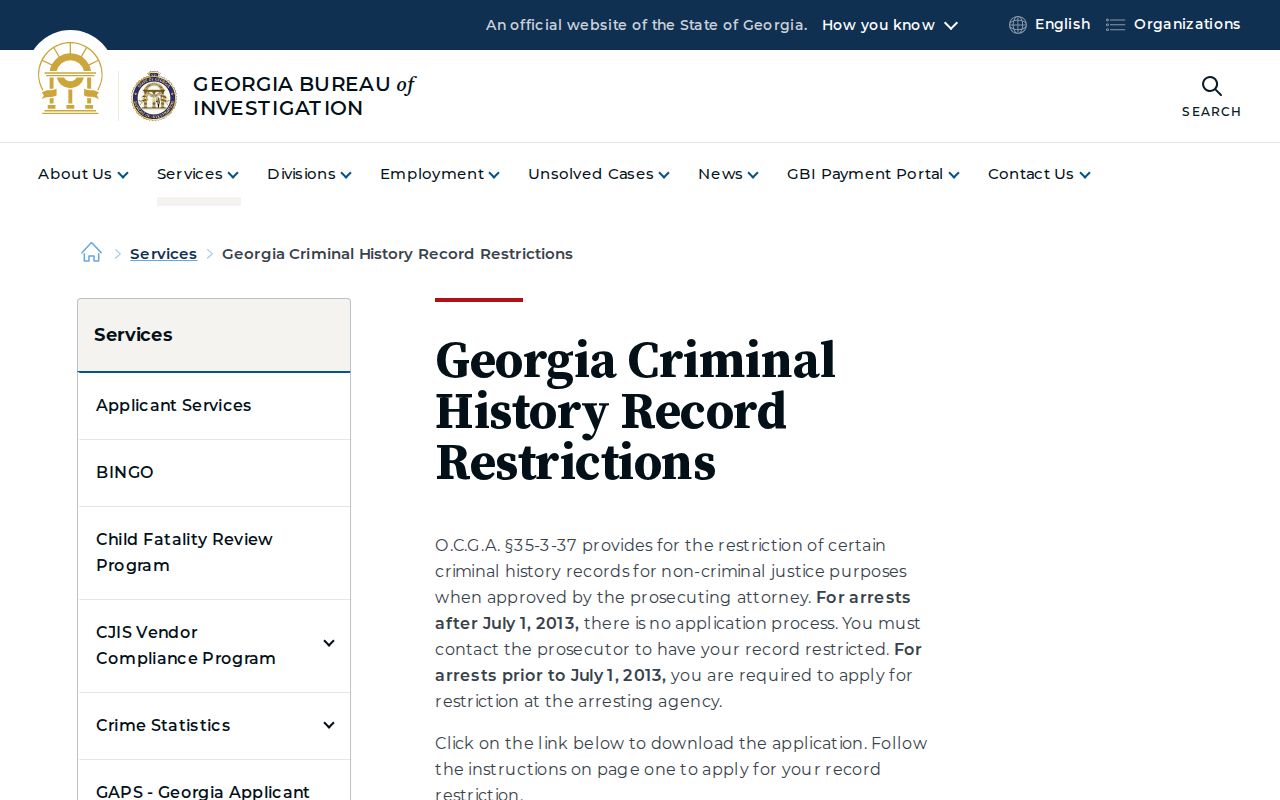
The distinction prevents a reader from assuming that restriction of an arrest cycle automatically ends a registry duty.
The state workflow offers more detail on restriction procedure.
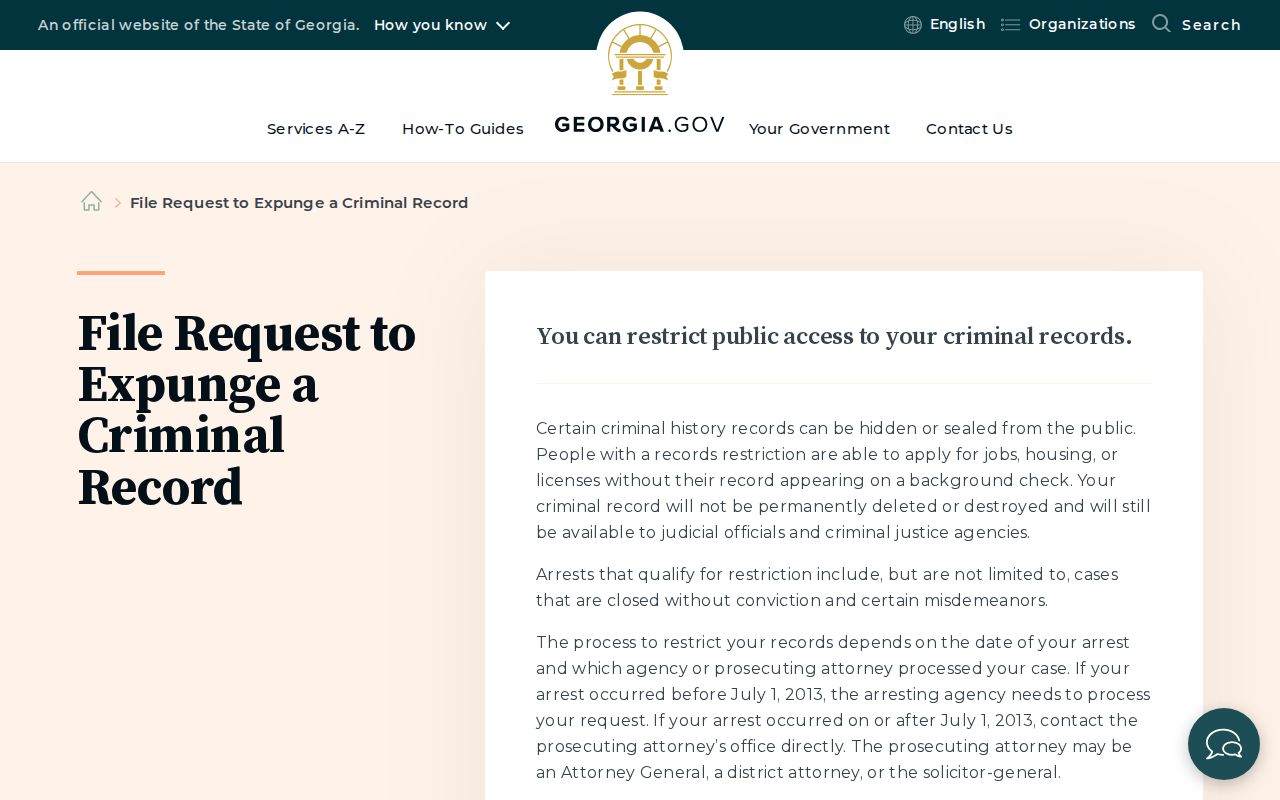
A Towns County registry release question belongs in the appropriate Superior Court process, not in a general open-records request.
Why Towns Search Results Vary
A missing result has more than one possible cause. Search data may be wrong, a recent submission may still be moving through the linked agencies, the person may not meet Georgia's registration criteria, or the person may have died or been removed through a lawful process. Successful completion under the First Offender Act can also affect publication in qualifying circumstances.
Try a careful name search, then use the Towns County filter. If the concern is an incorrect local address, call the sheriff. Do not substitute Georgia Felon Search for the registry. Felon Search is a paid product limited to reported Georgia felony convictions and does not answer whether a person has a current duty to register.
Using Registry Information Lawfully
Registry data supports personal, family, and community safety awareness. It can help a Towns County resident understand a listed offense, compare identifiers, and direct a factual concern to law enforcement. It does not authorize threats, harassment, intimidation, vigilantism, or contact with a listed person or household.
Use the registry lawfully. Misusing Georgia Sex Offender Registry information to harass, threaten, or intimidate can be a crime. O.C.G.A. §42-1-12 governs registration and public registry use. Report suspected noncompliance to law enforcement.
The Georgia Attorney General's open-government guidance also explains that public access remains subject to law and exemptions.
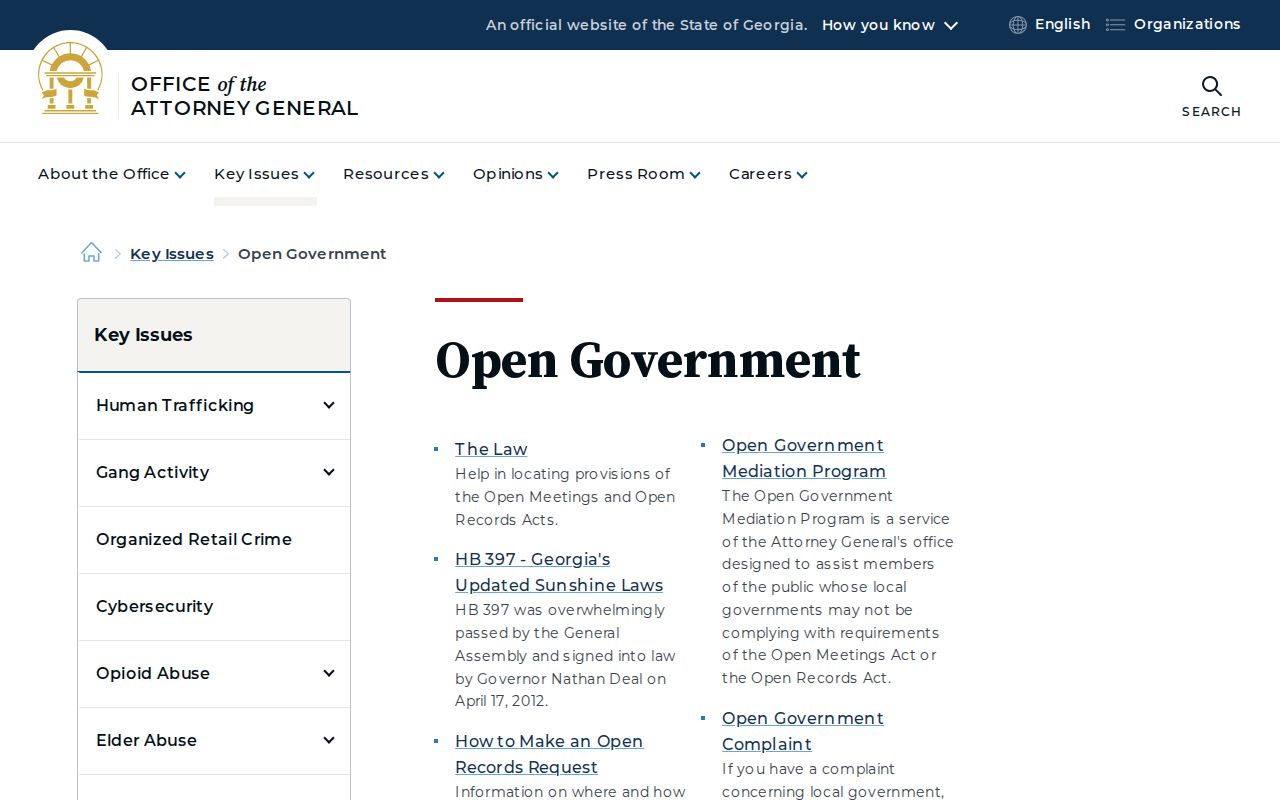
Public availability is a route to informed, safe reporting, not a license to punish or confront anyone.