
Criminal Court Cases in Towns County
Superior Court is the primary trial court for Towns County felony cases. It has exclusive felony trial jurisdiction, and Towns County sits in the Enotah Judicial Circuit. The Clerk of Superior Court maintains the criminal docket and filed papers at 48 River Street, Suite E, on the second floor of the courthouse complex in Hiawassee. The clerk lists weekday hours of 8:30 a.m. to 4:30 p.m. and can be reached at 706-896-2130.
Magistrate proceedings can cover arrest warrants, first appearances, bond issues, and preliminary steps before a felony prosecution reaches Superior Court. Probate or Magistrate Court is listed at the same River Street complex in Suite C, with telephone 706-896-3467. A city traffic or ordinance matter may instead remain with the municipal court that issued it. The court name printed on a citation, bond paper, or notice is therefore an important routing clue.
Three Towns Court Records to Request
A broad request for a complete file may be slower or less precise than naming the documents needed. For a Towns County criminal case, ask separately for the docket, the charging paper, and the judgment or final order. The docket is the chronological index. The accusation or indictment states the filed charges. The judgment records the adjudication and sentence.
Ask whether companion case numbers exist when one arrest led to several accusations. If an authenticated result is needed, ask the Towns clerk whether a certified copy is available and what the current fee is. The official local pages inspected did not publish copy or certification prices, so no fixed amount should be assumed before ordering.
Towns County Case Record Searches
The Towns Clerk is the authoritative access point. Georgia Courts maintains an E-Access directory for courts that use account-based providers, but Towns Superior Court is not shown on its participating list. The statewide request portal also should not be treated as proof of Towns participation. Call the clerk before relying on a remote service, and use exact identifiers from a citation, bond paper, or GCIC history.
- Identify the court from the citation, warrant, bond paper, hearing notice, or other source document.
- Call the Towns Clerk at 706-896-2130 and ask for the criminal docket or case file, not a property-record search.
- Give the case number when known, plus the party's full name, filing year, and charge to reduce false matches.
- Request the docket first, then identify the charging paper, motions, judgment, and sentence entries needed.
- Confirm the copy, certification, payment, delivery, archive, and courthouse inspection rules before placing an order.
| Field Label | Type | Required | Notes |
|---|---|---|---|
| Case number | Identifier | Best field | Use the exact court number, including its year or prefix. |
| Full party name | Text | Fallback | Include spelling variants or a former name when relevant. |
| Filing year | Year | Helpful | Narrows a common-name request and guides archive checks. |
| Charge or case type | Text | Helpful | Distinguishes a criminal file from the clerk's other records. |
| Arrest date or OTN | Identifier | Correction use | Helps match a missing GCIC disposition to the court event. |
Why Towns Court E-Access Stops Short
The Georgia Courts E-Access page is a directory, not one comprehensive statewide trial-court database. It sends users to providers used by participating courts. Towns Superior Court was not on the participating list reviewed for this research, and no official anonymous local case search or sample Towns criminal case was accessible.
This gap changes the search sequence. A name search on an unrelated provider cannot establish that Towns has no file. Start with the Towns Clerk, ask whether remote access has changed, and request an index check or counter inspection. Older material may require an archive search, so give a useful date range and confirm any retrieval rule before travel.
The official Georgia Courts E-Access directory illustrates the provider routing used by listed courts. The absence of Towns from that directory is why direct clerk confirmation remains essential.
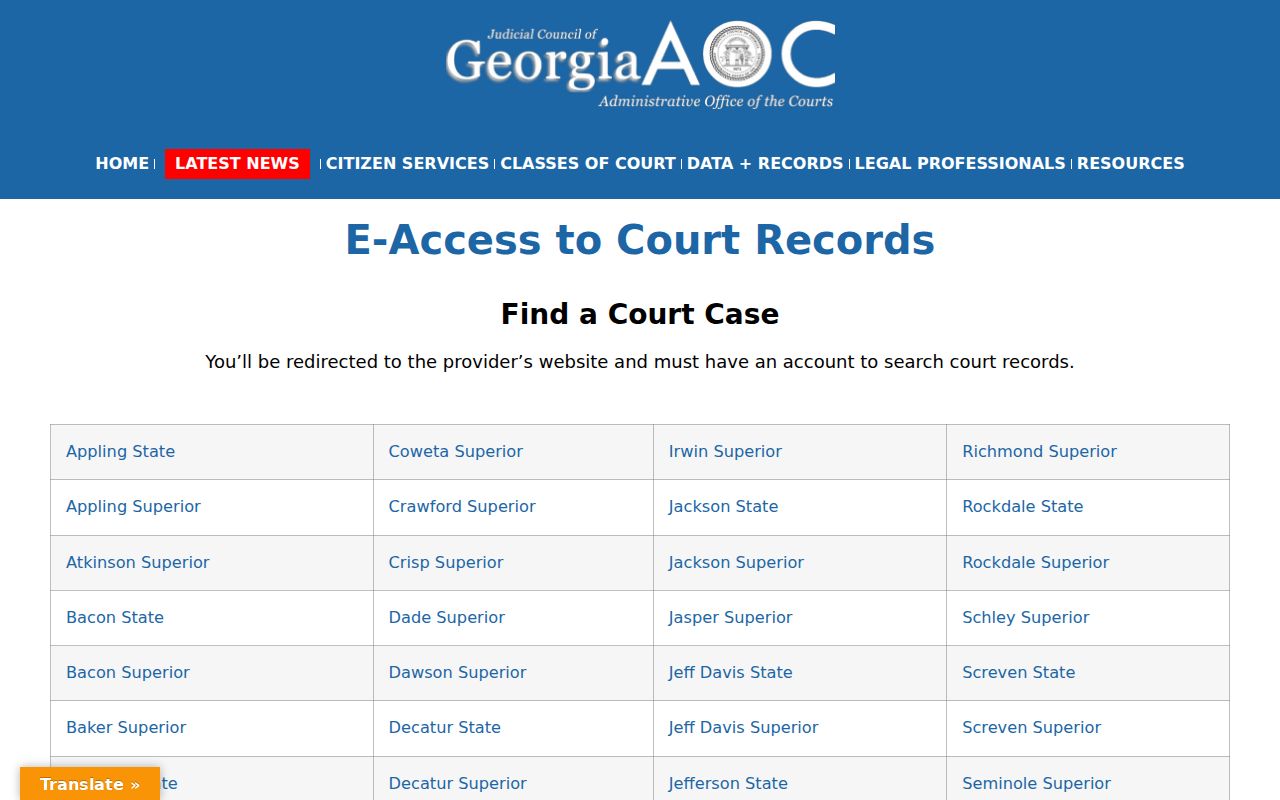
The directory image should be read as an access map, not as a complete Towns County criminal docket.
The official Georgia statewide court-record request portal is another possible routing service, but Towns participation must still be confirmed with the clerk.
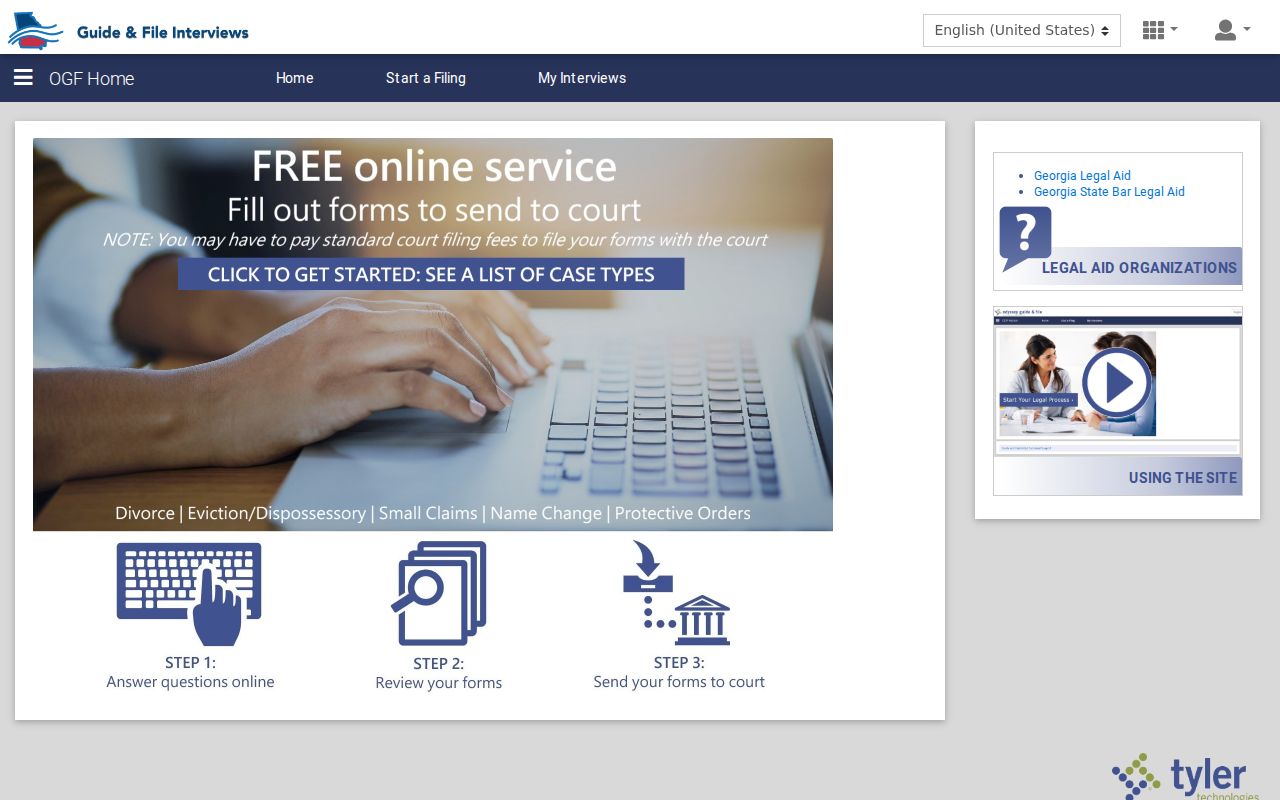
The portal image documents a statewide request channel, not guaranteed online access to Towns criminal cases.
What a Criminal Case File Contains
A Towns County criminal case file follows the prosecution after charges are filed. It may contain an accusation or indictment, hearing notices, motions, pleas, docket entries, final disposition, and sentence. The docket helps locate those documents, but its short entry text may not capture the terms of a full order. Read the filed judgment before drawing a conclusion from a charge label.
| Case Number & Court | Identifies the proceeding, filing court, and related docket. |
|---|---|
| Charging Document | States the allegations formally filed by indictment, accusation, or another authorized path. |
| Docket Entries | Chronological index of filings, notices, hearings, motions, and orders. |
| Hearing Dates | Shows scheduled and recorded court events; a continuance may change the calendar. |
| Disposition & Judgment | Records dismissal, plea, verdict, acquittal, or other final action in its proper document. |
| Sentence & Conditions | May combine custody, probation, fines, restitution, conditions, and credit for time served. |
Towns Court Dispositions in Plain Terms
A charge and an outcome are not the same field. A dismissal ends the filed charge through court action. A nolle prosequi reflects a prosecutor's decision not to proceed at that time. A no-bill means a grand jury did not return the proposed felony charge. A dead docket suspends active prosecution and is not the same as a dismissal.
- Guilty plea
- The defendant admits guilt and the court enters adjudication and sentence under the governing procedure.
- Guilty verdict
- A fact finder returns guilt after trial; the judgment and sentence supply the final terms.
- Acquittal
- The fact finder returns not guilty, which differs from dismissal before a trial result.
- First Offender
- A Georgia statutory path whose successful discharge can affect GCIC visibility, but court-file sealing is a separate question.
- Record restriction
- Limits eligible GCIC dissemination under Georgia law; it does not automatically erase every courthouse document.
Criminal Case Stages in Towns County
An arrest may lead first to warrant, appearance, or bond proceedings while a prosecutor reviews the police submission. It does not itself create a felony conviction file. After filing, arraignment records a plea. Discovery, motions, continuances, bond review, calendar notices, and hearings can follow. The matter may end through a negotiated plea, dismissal, or trial result, followed by judgment and any sentence.
Case flow: Charges Filed › Arraignment › Pretrial › Plea or Trial › Disposition › Sentencing
No official Towns source published standard time estimates for these stages. The docket is the best record of what happened in one case. A sentence may include concurrent or consecutive terms, supervision, fines, restitution, conditions, and custody credit. Later revocation litigation can add entries to the same or a linked docket.
Repairing a Missing Towns Case Disposition
A GCIC history can show an arrest cycle without its final court result when reporting is incomplete. GBI instructs the person to contact the appropriate court, which may send the disposition electronically. GCIC cannot guess which order belongs to an arrest or independently rewrite data owned by the originating agency.
Give the Towns Clerk the GCIC arrest date, OTN or SID when available, Towns case number, charge, and final order. The clerk may need a copy of the criminal history to make the match. Ask whether the disposition was transmitted, then allow GCIC to process the update. Arrest-data errors instead begin with the police agency that submitted the arrest.
Access Rules for Case Records
Georgia court records are generally public, but access is not absolute. Juvenile matters, sealed filings, protected victim information, personal identifiers, and records covered by a court order may be withheld or redacted. An online absence also may reflect the lack of a Towns portal, an archive issue, a name variation, or reporting delay rather than a sealed case.
Georgia record restriction under O.C.G.A. §35-3-37 governs eligible GCIC dissemination. Successfully discharged First Offender records may receive GCIC treatment under O.C.G.A. §§42-8-60 and following. Neither should be described as an automatic purge of the court file. Ask the clerk what remains public under the specific order and whether a separate sealing decision exists.
Note: Confirm current copy, certification, payment, inspection, and archive rules with the clerk because local fees were not officially published.
Preparing a Towns Court Clerk Request
The courthouse and jail are separate record locations. Court pleadings and dispositions belong at the second-floor clerk counter on River Street, while incident, booking, and custody records begin at the sheriff complex on State Highway 339. Going to the office that owns the document avoids a request that must be redirected.
Before visiting, call about courthouse access, device use, inspection space, payment, and certification. Official Towns sources do not publish security, parking, photography, appointment, or copy-fee rules. Bring the case number and a short document list, and ask about archive retrieval when the filing is old.